
Modern Mercedes-Benz transmissions are becoming more complex, and the correct servicing procedure is changing with them.
On many newer models, checking the automatic transmission fluid is no longer a matter of removing a dipstick or opening a level plug until fluid begins to overflow. Some transmissions now require an ultrasonic measuring tool to determine the fluid level through the transmission oil pan.
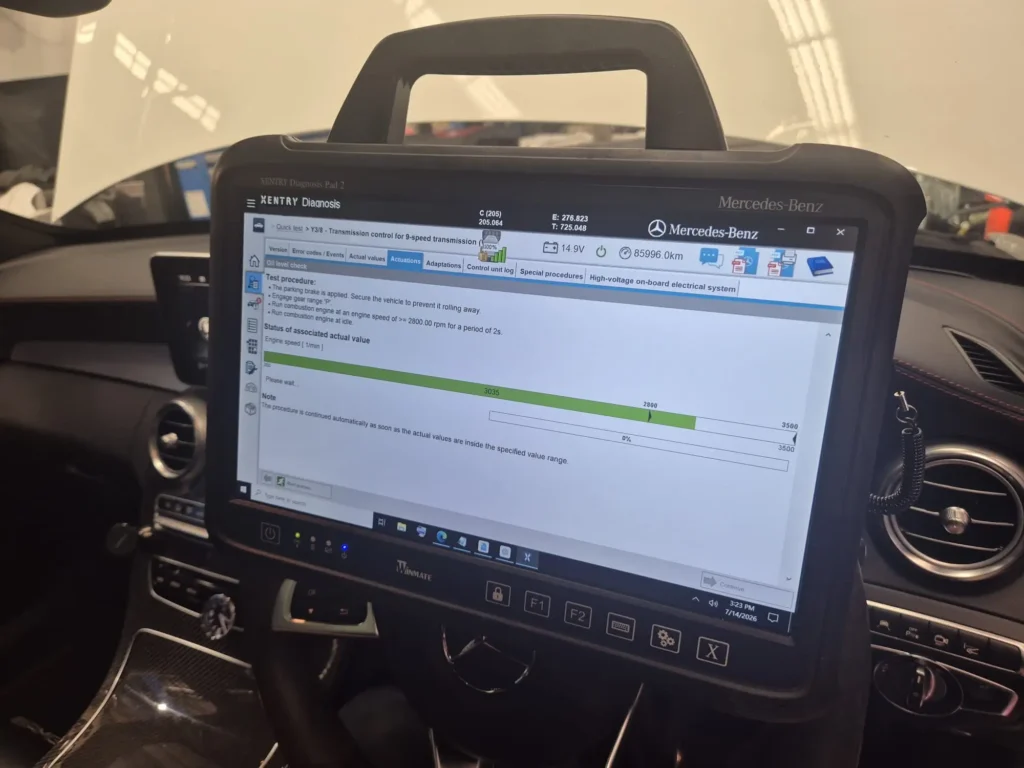
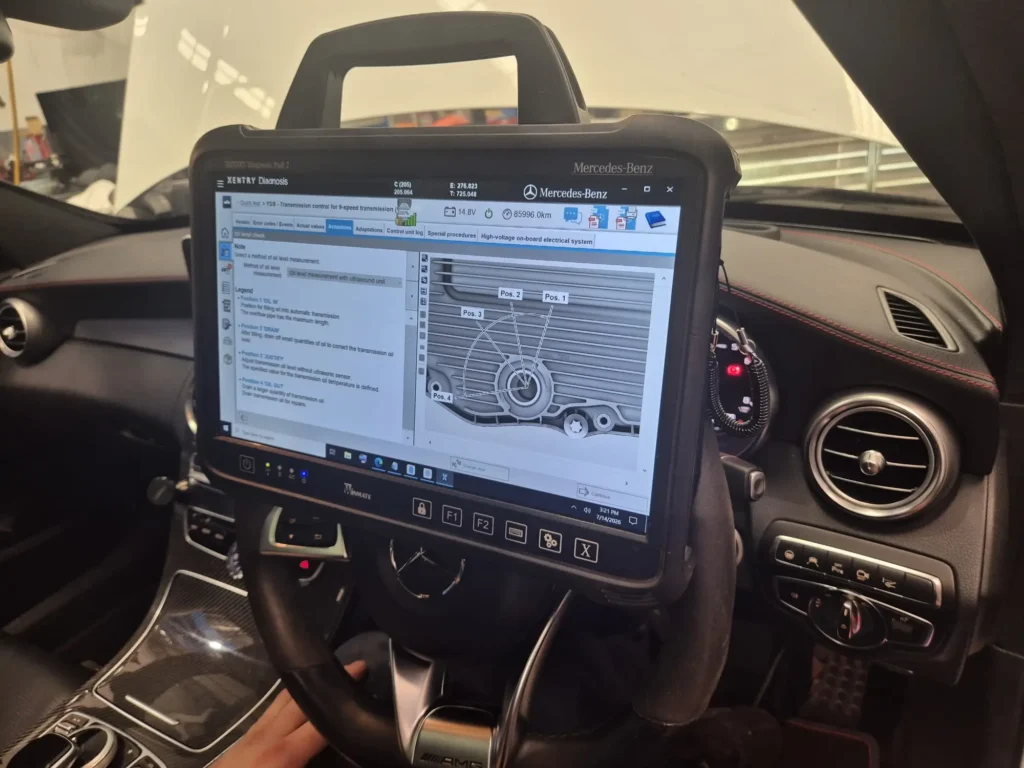
The reading is then compared with live transmission data using the Mercedes-Benz XENTRY diagnostic system. This allows the fluid level to be adjusted according to its temperature, rather than relying on a fixed measurement or visual estimate.
For Mercedes-Benz owners, this is an important development. A workshop may be able to drain and refill the transmission, but that does not necessarily mean it has the equipment needed to verify the final fluid level correctly. This is one of the reasons specialist Mercedes-Benz servicing increasingly depends on the right diagnostic tools rather than general workshop equipment alone.
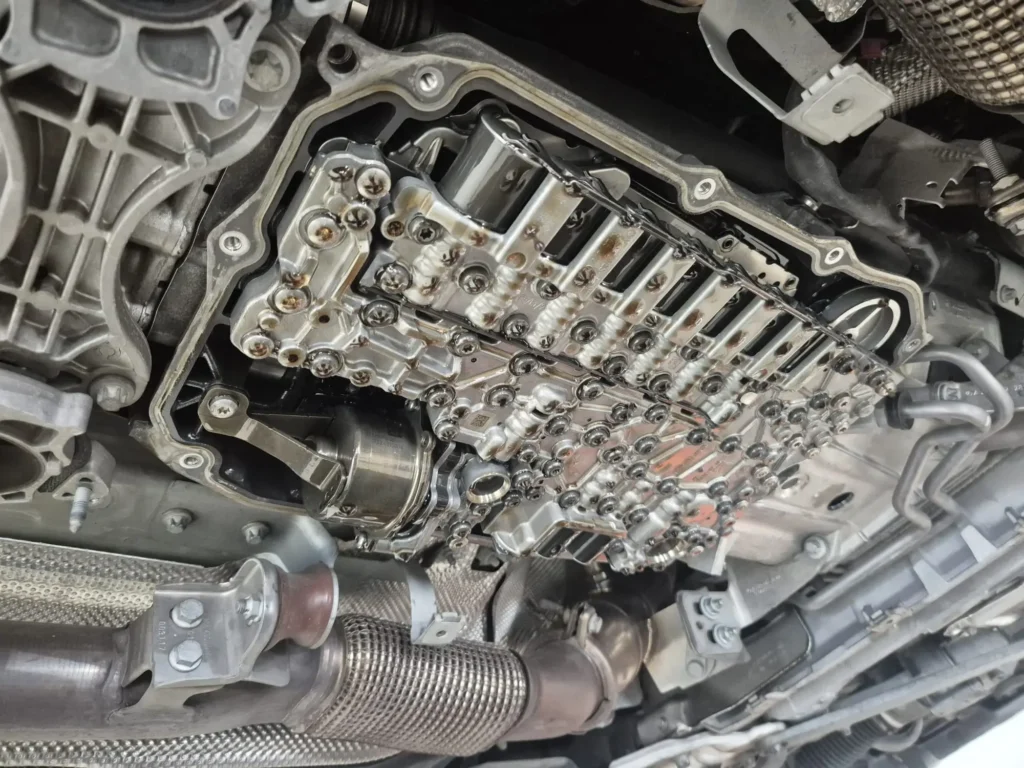
Why the Transmission Fluid Level Matters
Automatic transmission fluid performs several jobs inside the transmission.
It provides hydraulic pressure, lubricates internal components, helps control operating temperature and allows clutches and gear assemblies to operate correctly. The transmission depends on having the correct fluid specification and the correct quantity.
Even a relatively small difference in fluid level can affect how the transmission operates.
If the level is too low, the transmission may experience:
- Delayed engagement when selecting Drive or Reverse
- Harsh, hesitant or inconsistent gear changes
- Low hydraulic pressure
- Increased operating temperature
- Accelerated wear of clutches, bearings and internal components
- Transmission warning messages or fault codes
Too much fluid can also create problems. Overfilling may cause the rotating components to aerate or foam the fluid, reducing its ability to lubricate and maintain stable hydraulic pressure. It can also contribute to leaks, pressure irregularities and poor shift quality.
This is why Mercedes-Benz specifies a precise process for checking and correcting the level.
The Traditional Method of Checking Transmission Fluid
Older Mercedes-Benz vehicles may use a transmission dipstick, although the dipstick was not always supplied with the vehicle and could require a workshop service tool.
Other transmissions use an overflow or standpipe arrangement inside the transmission sump. Fluid is pumped into the transmission and checked at a specified temperature, typically around 85 to 90 degrees Celsius. Once excess fluid drains through the overflow, the remaining quantity should correspond with the intended level.
This method can work accurately when the correct procedure is followed. However, it depends on several factors, including:
- Transmission fluid temperature
- Vehicle position
- Engine operating conditions
- The correct filling equipment
- The technician interpreting the flow from the overflow system
- Completing the procedure within the specified temperature range
As transmission designs have changed, Mercedes-Benz has introduced a more direct measuring process for applicable models.
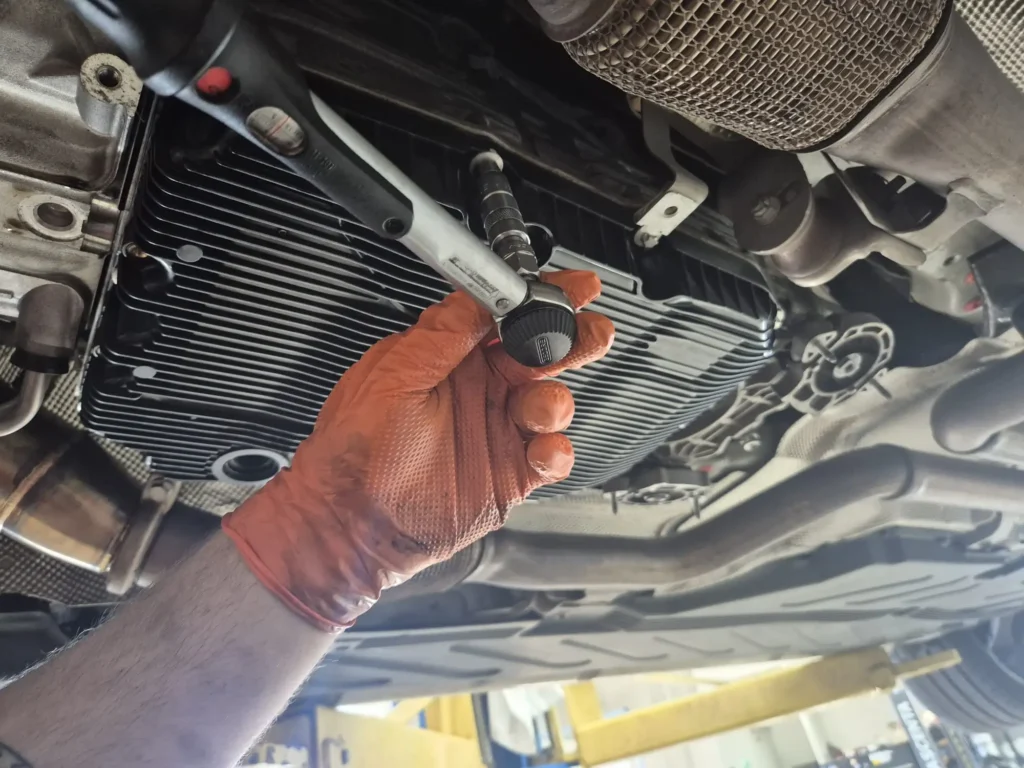
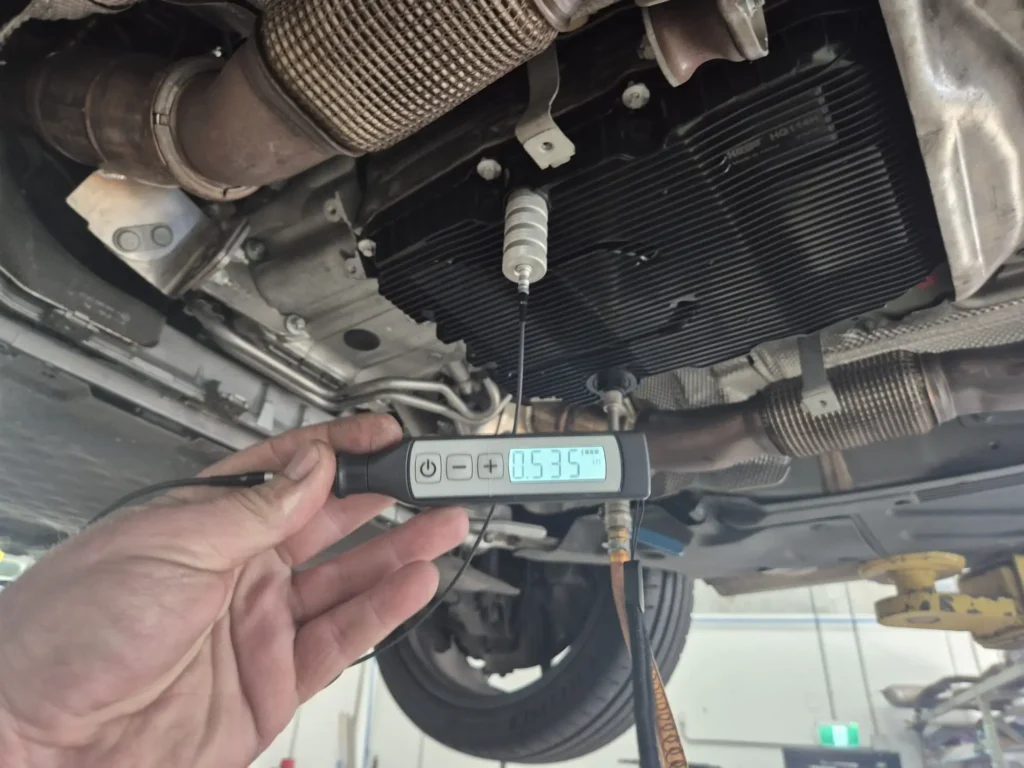
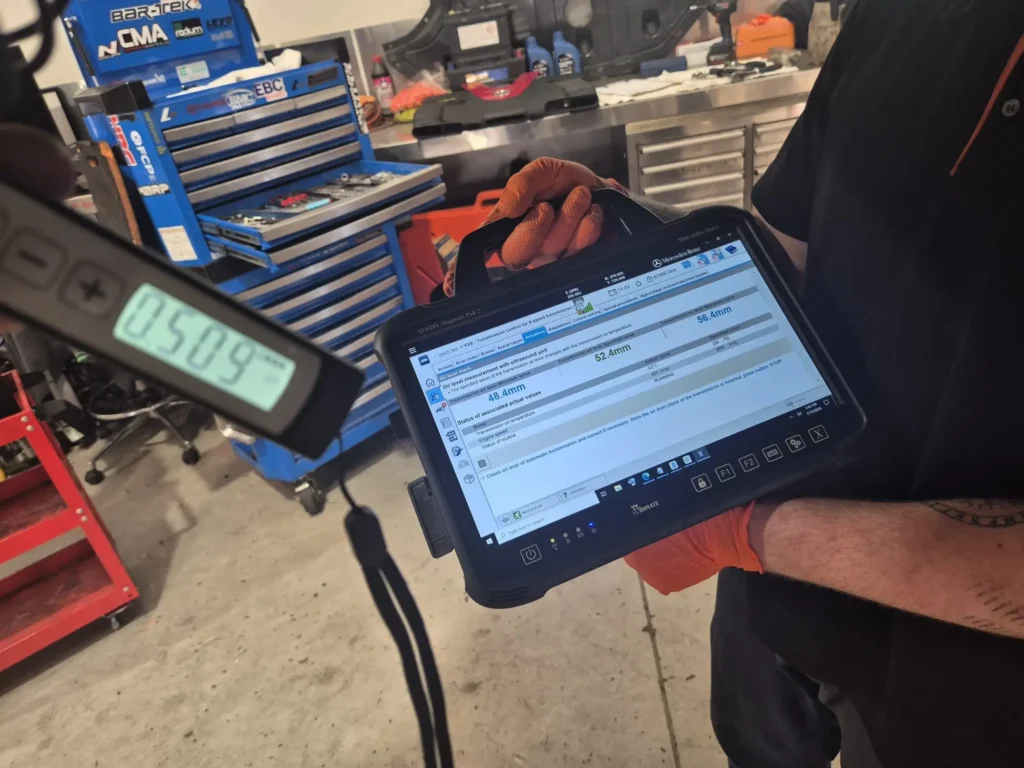
The New Ultrasonic Transmission Fluid Level Procedure
On many current Mercedes-Benz transmissions, a dedicated ultrasonic sensor is used to measure the actual height of the fluid inside the transmission sump.
The measuring probe is fitted to a designated point on the underside of the transmission oil pan. It sends an ultrasonic signal through the pan and uses the returning signal to calculate the fluid level.
The technician then uses the measurement alongside live data from the Mercedes-Benz XENTRY diagnostic system.
XENTRY provides information such as:
- Current transmission fluid temperature
- The required fluid level for that temperature
- Vehicle-specific servicing instructions
- Transmission preconditioning procedures
- The measured and specified fluid level values
- Instructions for adding or removing fluid
The result is a temperature-corrected measurement rather than a simple visual level check.
Why Transmission Fluid Temperature Changes the Reading
Automatic transmission fluid expands as it becomes warmer.
This means a transmission containing the correct amount of fluid will show a different fluid height when cold than it will after the transmission reaches operating temperature.
A measurement taken without considering temperature can therefore be misleading. The fluid may appear low while cold or too high once warm, even though the actual quantity has not changed.
The Mercedes-Benz procedure accounts for this by comparing the ultrasonic reading with the fluid temperature reported through XENTRY.
For example, the diagnostic system may show:
- The current fluid temperature
- The ultrasonic measurement taken at the sump
- The calculated target level at that temperature
- Whether fluid needs to be added or removed
This allows the technician to set the level according to the vehicle’s actual operating conditions.
The Ultrasonic Tool Is Only One Part of the Procedure
Owning the measuring device alone is not enough.
The process also requires access to the correct Mercedes-Benz diagnostic functions and model-specific workshop instructions. Depending on the transmission, the technician may need to:
- Drain the existing transmission fluid.
- Remove the transmission sump.
- Replace the filter or sump assembly as required.
- Inspect the drained fluid and sump for signs of wear or contamination.
- Refit the sump using the correct seals and tightening procedure.
- Refill the transmission with the specified Mercedes-Benz-approved fluid.
- Connect the XENTRY diagnostic system.
- Carry out the required transmission preconditioning process.
- Cycle the transmission through the specified gear positions.
- Monitor the transmission fluid temperature.
- Attach the ultrasonic measuring probe.
- Compare the measured fluid height with the XENTRY target value.
- Add or remove fluid until the correct temperature-adjusted level is reached.
- Complete a final inspection and road test.
The exact process varies between transmissions and vehicle models. This is why the workshop instructions must be checked for the individual vehicle rather than applying one universal filling method.
No Dipstick and No Conventional Level Plug
One of the challenges for owners is that some newer Mercedes-Benz transmissions provide no practical way to confirm the fluid level without specialist equipment.
There may be:
- No owner-accessible transmission dipstick
- No conventional level plug
- No simple fluid mark that can be checked manually
- No reliable way to confirm the final level from the quantity added alone
Filling the transmission with a published capacity is not always sufficient.
The amount drained can vary depending on how long the vehicle is allowed to drain, whether the torque converter and cooler circuits retain fluid, which parts are replaced and whether the transmission has previously been underfilled or overfilled.
The listed fluid capacity is therefore a starting point. The final level still needs to be checked using the procedure specified for the transmission.
Which Mercedes-Benz Models Use This Method?
The ultrasonic procedure applies to selected newer Mercedes-Benz transmissions rather than every model.
It is associated with a number of current transmission families, including applications using the 9G-TRONIC automatic transmission and newer dual-clutch transmissions fitted to Mercedes-Benz compact models.
Depending on the year, drivetrain and transmission fitted, the procedure may apply to vehicles from ranges such as:
- A-Class
- B-Class
- CLA
- GLA
- GLB
- C-Class
- E-Class
- GLC
- GLE
- GLS
- CLS
- S-Class
- Selected Mercedes-AMG models
Fitment should always be confirmed using the vehicle identification number and the Mercedes-Benz workshop information for the exact transmission.
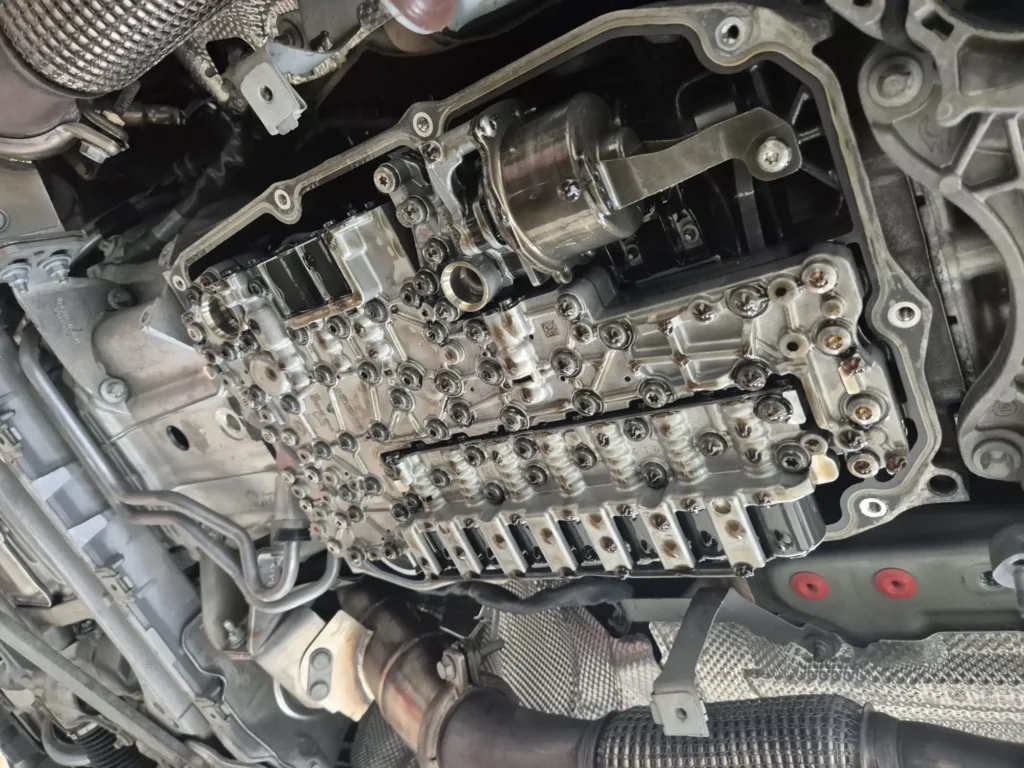
The W205 C-Class shown in our workshop photos has another approved method available for checking its transmission fluid level. However, the ultrasonic equipment is essential on other applications, including selected newer A-Class models where there is no suitable conventional alternative.
Why We Invested in the Mercedes-Benz Ultrasonic Tool
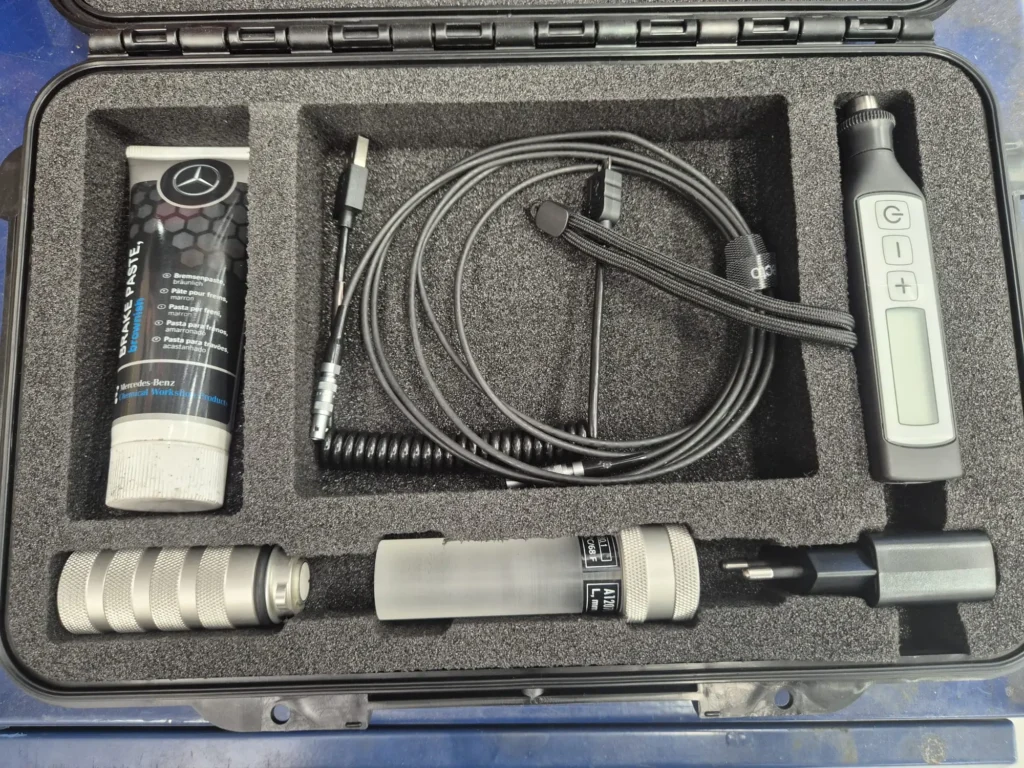
The ultrasonic measuring kit is a highly specialised piece of workshop equipment costing approximately $2,000.
We purchased it so that applicable Mercedes-Benz transmission services can be completed according to the current level-setting procedure, rather than relying on fluid quantity estimates or an unsuitable generic method. It reflects the same approach we take across our Mercedes-Benz servicing and diagnostics: using the correct factory equipment for the job.
We use the tool in combination with our original Mercedes-Benz XENTRY diagnostic system. This allows our technicians to view the relevant transmission data and compare the measured fluid height with the specified value for the current temperature.
To our knowledge, very few independent workshops in Perth have invested in this equipment. You can read more about our workshop and approach if you would like to know how we work.
It is not a tool that will be needed on every vehicle entering the workshop. However, when a transmission requires this procedure, there is no meaningful substitute for having the proper measuring equipment and diagnostic access available.
Can the Fluid Level Be Estimated from the Amount Drained?
Measuring the amount of fluid removed can be useful, but it should not be treated as the final level check.
A transmission may already have an incorrect level before servicing due to:
- A previous servicing error
- A fluid leak
- An incorrectly completed repair
- Fluid loss during earlier diagnostic work
- An unsuitable filling procedure
Refilling exactly the amount that was drained could simply reproduce the existing problem.
Some fluid also remains inside the transmission, torque converter, cooler and hydraulic circuits. The amount retained can differ between vehicles and servicing conditions.
The final level must therefore be confirmed using the method specified for the particular transmission.
Does a Sealed Transmission Still Need Servicing?
The term “sealed transmission” can be misleading.
It generally means the transmission has no conventional owner-accessible dipstick or routine top-up point. It does not necessarily mean the fluid will last indefinitely or that the transmission cannot be serviced.
Transmission fluid is exposed to:
- Heat
- Friction material
- Fine metallic particles
- Repeated pressure changes
- Oxidation
- Moisture and contamination
- Wear from normal operation
Over time, the fluid’s lubricating and hydraulic properties can deteriorate. The filter may also collect debris and become restricted.
The appropriate service interval varies according to the transmission, vehicle model, operating conditions and Mercedes-Benz maintenance schedule. Vehicles used for frequent short trips, towing, performance driving or extended operation in hot conditions may place greater demands on the transmission fluid. If you are weighing up when to book work in, our guide to car service and maintenance costs explains what to expect.
Signs Your Mercedes-Benz Transmission May Need Attention
A transmission fluid service is not a guaranteed repair for every transmission concern. However, the following symptoms should be investigated:
- Shuddering when moving away
- Harsh or delayed gear engagement
- Rough upshifts or downshifts
- Hesitation when selecting Drive or Reverse
- Transmission slipping
- Fluctuating engine speed during gear changes
- Fluid leaks beneath the vehicle
- Transmission warning messages
- Limp-home mode
- Unusual whining or mechanical noises
These symptoms can be caused by fluid level issues, fluid deterioration, software, electrical faults, valve body problems, clutch wear or internal mechanical damage. In some cases the fault is stored as a diagnostic trouble code, similar to the Mercedes fault codes we diagnose in the workshop, and occasionally the concern is resolved through transmission control unit calibration rather than mechanical repair.
The vehicle should be diagnosed before assuming that a fluid change alone will correct the problem.
Why the Correct Fluid Specification Is Essential
Accurate fluid level is only part of a proper transmission service.
Mercedes-Benz uses different fluid specifications across its transmission range. Fluids can differ in viscosity, friction characteristics, additive packages and compatibility with internal materials.
Using a fluid that is described simply as “suitable for Mercedes” may not be enough. The required Mercedes-Benz specification must be confirmed for the vehicle and transmission.
The filter, sump, seals and single-use fasteners must also be selected according to the exact application.
Using an incorrect fluid can affect shift quality, clutch operation, lubrication and long-term durability, even when the level has been set accurately.
Mercedes-Benz Transmission Servicing in Perth
Mercedes-Benz transmission servicing has become increasingly dependent on specialist equipment, current technical information and factory-level diagnostics.
For applicable vehicles, our technicians can use the ultrasonic measuring system alongside Mercedes-Benz XENTRY to check and adjust the fluid level according to its actual temperature.
This provides a more accurate result than relying solely on the amount of fluid added or applying an older procedure to a transmission that was designed for a different method.
If your Mercedes-Benz is due for a transmission service, has developed a fluid leak or is showing changes in shift quality, contact Eurotech Autohaus in Bayswater. We can identify the transmission fitted to the vehicle, confirm the required procedure and provide an appropriate servicing or diagnostic recommendation.
Frequently Asked Questions
On many newer Mercedes-Benz models, no. The vehicle may not have a conventional dipstick or accessible level-checking system. Specialist filling equipment, diagnostic data and, on applicable transmissions, an ultrasonic measuring tool may be required.
No. The correct procedure depends on the vehicle, transmission type and production date. Some transmissions use a dipstick or overflow method, while others require ultrasonic measurement.
The transmission’s pump must circulate fluid through the hydraulic system, torque converter and internal passages. The vehicle may also need to be moved through specified gear positions so the fluid is distributed correctly before the final level is checked.
Yes. An incorrect level or unsuitable fluid can affect hydraulic pressure and clutch operation. Rough shifting can also have other causes, so diagnosis may still be required.
No. It is a separate workshop measuring device that is attached to the transmission sump during the level-checking procedure.
XENTRY provides the live temperature data, model-specific targets and guided servicing process required to interpret and correct the ultrasonic measurement accurately.
About the Author

Rainer Scholz is the Workshop Manager and a diagnostic specialist at Eurotech Autohaus, an independent European vehicle workshop in Bayswater, Perth.
A German-trained master tradesman with over 20 years of experience on European and German cars, he is confident across the full range of factory and aftermarket diagnostic equipment, including the genuine Mercedes-Benz XENTRY system and specialist tooling covered in this article.
His focus is precise, procedure-correct servicing backed by proper diagnostics. Eurotech Autohaus is a licensed Motor Vehicle Repairer (MRB9066) and MTAWA member, servicing prestige and performance European vehicles across Perth’s north-eastern suburbs.
SERVICE QUOTE
24 Radius Loop, Bayswater WA 6053
Monday – Thursday: 7:30am – 5pm
Friday: 7:30am – 4pm
Our Services
AdBlue System Servicing & Repairs
- AdBlue Fault Diagnosis
- AdBlue Warning & Countdown Reset
- Metering Valve & Injector Replacement
- AdBlue Pump & Tank Repairs
- NOx & Level Sensor Replacement
- SCR Catalyst Crystallisation Cleaning
- Mercedes, BMW, Audi, VW & More
Brake Servicing
- Brake Inspection & Diagnosis
- Disc Brake Service
- Drum Brake Service
- Master Cylinder
- ABS Diagnosis
- Brake Fluid Flush
Car Electrical Services
- All lighting and modifications
- Control module diagnosis
- Alternators, Batteries
- Starters
- Air Bag System Diagnosis and repair
- Accessories and upgrades
- Windshield Wipers & Washers
Collision Advice
- Insurance Claims
- Vehicle Restoration
- Body Kits
- Glass Replacement
- Custom Graphics
- Interior & Exterior Trim
- All Makes and Models
Comfort System
- Air Conditioning Service
- System Diagnosis
- Heater Core
- A/C Compressors
- Blower Motors
- Climate Control System
Cooling System
- Leak Diagnosis
- Overheating Diagnosis
- Water Pumps
- Radiators
- Cooling Fans
- Coolant Hoses
- Thermostats
Engine Performance
- High Performance Upgrades
- Drivability Diagnosis
- Fuel Injection Service
- Computer System Diagnosis
- Maintenance Tune-Up
- Emission Diagnosis & Repair
- “Check Engine” Light Diagnosis
Engine Servicing
- Oil Leak Diagnosis
- Timing Belts
- Performance manifolds and accessories
- Head Gaskets
- Engine Replacement
- Engine Service
- Exhaust System Replacement & Repair
- Performance Upgrades
Maintenance Services
- Factory protected log book servicing
- Full 100 safety point inspections
- Transmission Service
- Cooling System Flush
- Tyre Rotation & Balance
Pop and Crackle Tunes (Burble Tunes)
- Stage 1 Tuning
- Stage 2 Tuning
- Stage 3 Tuning
- Fuel Efficiency Tuning
- Engine Remapping