
You have just picked up your Porsche, BMW M or Mercedes-AMG from a service, the pads are fresh, and the first slow stop at the lights lets out a high-pitched squeal. Nothing feels wrong with the pedal. The car pulls up straight. So why are the brakes squeaking?
Squeaky brakes are one of the most common questions we field from European and performance car owners in Perth, and the answer is not what most people expect. In many cases brake squeal is a by-product of how a high-performance braking system is designed, not a sign that something has failed. In other cases it is an early warning worth acting on.
This guide explains what brake squeal actually is, why European and performance vehicles are more prone to it, how to tell harmless noise from a real problem, and what can be done to reduce or fix squeaky brakes.
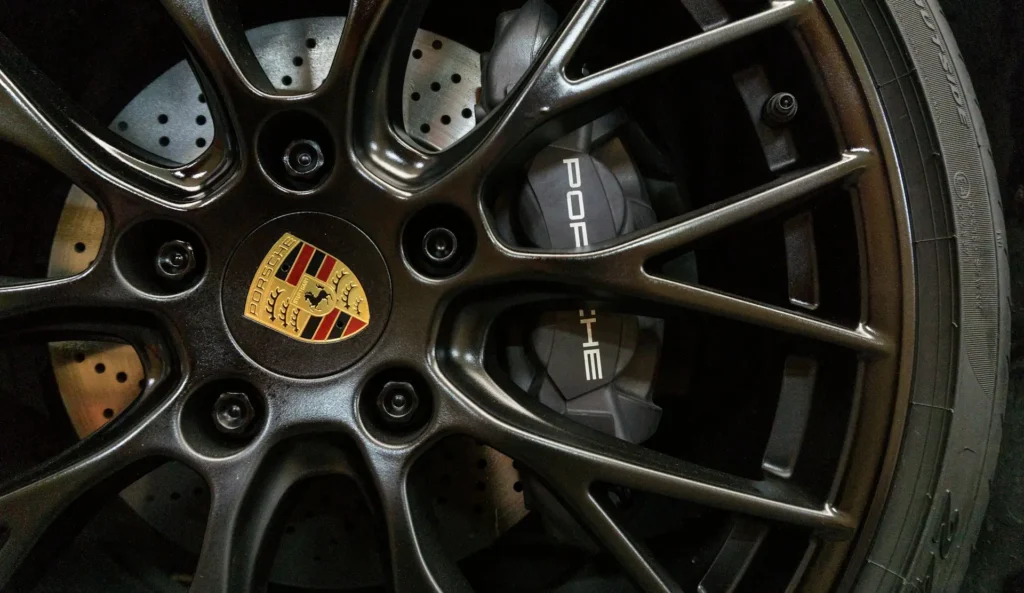
What Is Brake Squeal?
When you press the brake pedal, the pads clamp onto the disc and convert the car’s motion into heat through friction. That friction is never perfectly smooth. At a microscopic level the pad grips and releases the disc surface thousands of times a second, a behaviour engineers call stick-slip.
Those tiny grip-and-release cycles create vibration. When the vibration frequency lines up with the natural resonance of the disc, pad, caliper or hub, the components start to ring together and the disc acts like a speaker cone, amplifying the vibration into the squeal you hear. Every part in a braking system has its own natural frequency, and once they are bolted together they produce a complex set of coupled frequencies. If one of them lands in the audible range, you get noise.
The important point is that squeal is a vibration problem, not a wear problem. Brand new pads on freshly machined discs can squeal. Pads with 80 per cent of their material left can squeal. Whether it happens depends on the friction material, the geometry of the components, temperature, humidity and how the brakes are being used.
Why European and Performance Cars Squeal More Than Everyday Cars
If your daily runabout has never made a sound but your Audi RS, AMG or 911 chirps at every roundabout, you are not imagining it. There are several design reasons why squeaky brakes are more common on European and performance vehicles.
Aggressive, high-metallic pad compounds
European manufacturers tune their braking systems for stopping power first. That usually means semi-metallic or high-metallic pad compounds that bite hard, resist fade and deliver consistently high friction across a wide temperature range. The trade-off is that harder, more abrasive compounds are noisier and produce more brake dust than the softer, organic or ceramic pads fitted to many Japanese and Korean cars. It is also why European wheels go black so quickly.
Big discs, big pads, uneven pressure at low speed
Performance cars run large-diameter discs and long, wide pads, often with four, six or even ten-piston calipers, to cope with repeated hard stops. Across such a large contact area, pad pressure is not always evenly distributed, particularly during light, low-speed braking such as creeping up to a stop sign or reversing out of a driveway. Uneven pressure is one of the main triggers for stick-slip vibration, which is why the noise is usually worst at walking pace rather than under hard braking.
Brakes designed to work hot
Performance pads are formulated to work best once they reach operating temperature. Cold brakes on a short suburban trip, or the first few stops on a winter morning, are well below that window and much more likely to squeal. Once the system warms up the noise often disappears. Track-oriented and carbon ceramic setups such as Porsche’s PCCB are the extreme end of this, and some noise when cold is simply part of the ownership experience.
Humidity, corrosion and Perth conditions
Overnight moisture leaves a thin film of surface rust on cast iron discs. The first few stops of the day scrub it off, and that scrubbing is noisy. Cars that sit for days, live near the coast, or get washed and then parked are particularly prone to it. Humidity also changes the friction characteristics of the pad surface itself, which is why the same car can be silent one week and squealing the next without anything mechanically changing.
Lightweight components and less damping
Manufacturers spend a lot of effort damping brake noise with shims, weighted backing plates, chamfered and slotted pads and carefully tuned caliper stiffness. Performance models often strip weight from these areas, and aftermarket pads or discs that do not replicate the original design lose that damping altogether. The result is a system with less built-in tolerance for vibration.
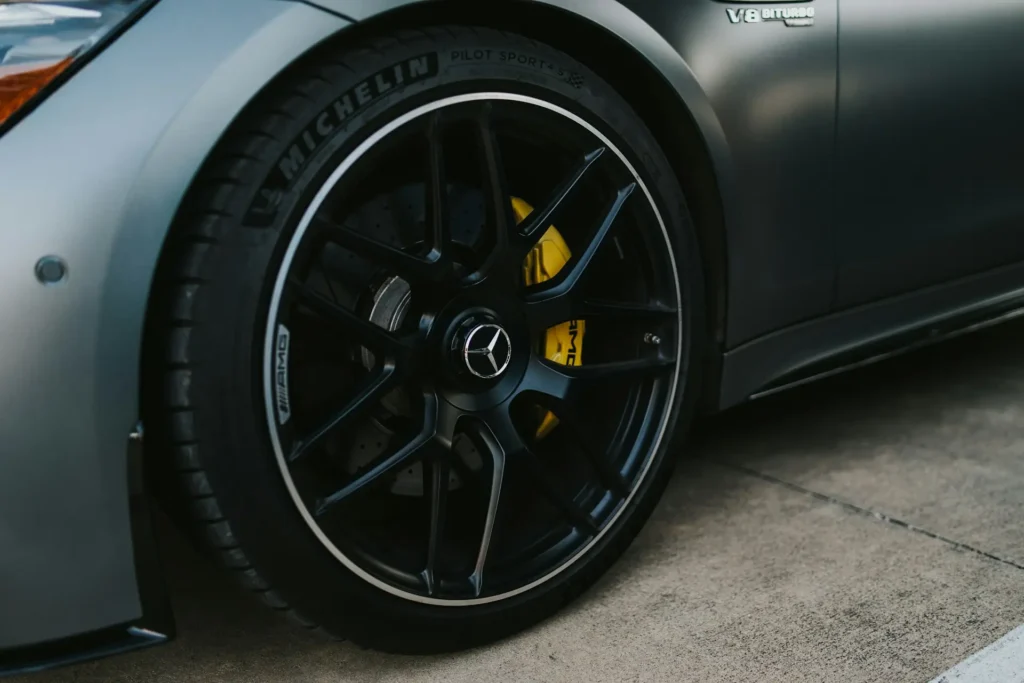
Porsche’s Take: Brake Squeal Explained
Porsche has produced a short video that explains this better than most workshops can. The key message is that on a braking system engineered for maximum performance, some squeal is inevitable and is not a defect. Porsche’s engineers design for consistently high friction across the whole temperature range and add weighted components to cancel specific frequencies, but they acknowledge that wear, temperature, humidity and corrosion can still trigger noise events. Their advice for isolated squealing is a few firmer stops on an empty road to normalise pad pressure distribution, and a visit to a service advisor if it persists.
The same principles apply to BMW M, Mercedes-AMG, Audi RS, Jaguar and Range Rover SVR, Maserati and any other vehicle running a performance-oriented brake package.
The Different Brake Noises and What They Mean
Not all brake noise is created equal. Being able to describe the sound accurately helps a technician diagnose it quickly.
- High-pitched squeal at low speed, especially when cold: Usually pad compound and vibration related. On a performance car this is the classic “normal” squeal.
- Squeal on the first few stops that goes away: Surface rust being cleaned off the discs. Common after rain, washing or a few days parked.
- Constant squeal or chirp while driving, without braking: Often a worn pad wear indicator tab contacting the disc, a sticking caliper slide, or a stone caught in the dust shield.
- Squeal after new pads were fitted: Pads not bedded in, incorrect or low-quality pad compound, missing shims or hardware, or discs that were not machined or replaced with the pads.
- Squeal only in reverse: The pad edge loading the disc from the opposite direction. Usually harmless but can point to pad chamfer wear or hardware issues.
- Grinding, scraping or a metallic growl: Metal-on-metal contact. Pads worn to the backing plate or a foreign object between pad and disc. Stop driving and have it inspected.
- Judder or pulsing through the pedal or steering wheel: Uneven pad deposits or disc thickness variation. Not a squeal, but a separate issue that needs attention.
When Brake Squeal Is Normal and When It Is a Problem
A squeal on its own, with no other symptoms, is very rarely a safety issue on a European or performance vehicle. If the pedal feels firm, the car stops straight and the wear indicator light is off, the brakes are almost certainly doing their job. The noise is annoying, not dangerous.
Book an inspection if the squeal comes with any of the following:
- A brake pad wear warning on the dash (most European cars have electronic wear sensors)
- Grinding or scraping sounds
- Vibration or judder under braking
- A soft, spongy or long pedal
- The car pulling to one side when braking
- A burning smell or a wheel that is noticeably hotter than the others after a drive
- A sudden change in the noise, or a squeal that appears out of nowhere on a car that was previously quiet
Any of these point to wear, a sticking caliper, contaminated pads or a hydraulic issue rather than simple resonance, and they will not fix themselves.
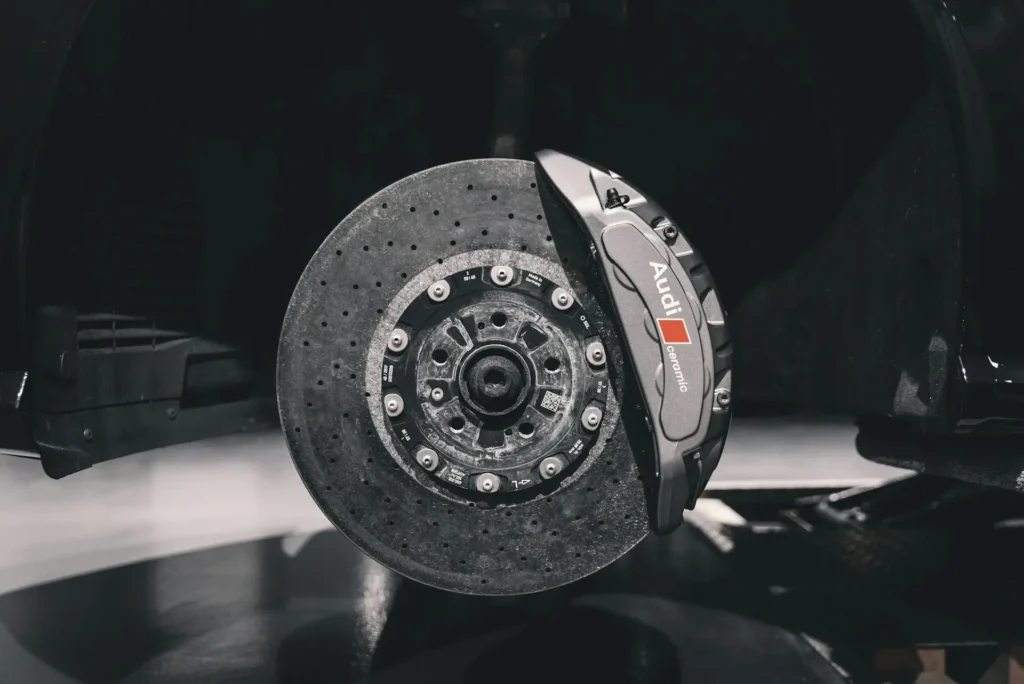
How to Fix Squeaky Brakes on a European or Performance Car
Because squeal has several possible causes, there is no single fix. These are the approaches that actually work, roughly in order from simplest to most involved.
1. Bed the brakes in properly
New pads and discs need a bedding-in procedure to transfer an even layer of friction material onto the disc face. Skipping it is the number one reason new brake pads squeal. If your pads are recent, a series of firm (not panic) stops from around 80 km/h down to 20 km/h on a quiet road, with a cooling drive afterwards and no holding the brakes at a standstill while hot, will often settle the noise within a few hundred kilometres. This is also the “firmer stops” advice Porsche gives in its video.
At Eurotech Autohaus, correct bedding-in is part of every brake job we do. Once new pads or discs are fitted, our technicians carry out the manufacturer-specified bedding-in procedure before the car is handed back, so the friction surfaces are properly mated and you are far less likely to drive away with a fresh set of squealing brakes.
2. Use the brakes the way they were designed to be used
Performance brakes that only ever see gentle, low-speed stops glaze over. The pad surface hardens and polishes, friction drops and squeal goes up. A few decisive stops now and then keeps the pad face fresh. Riding the brakes lightly down a long hill, on the other hand, is the fastest way to glaze them.
3. Clean and lubricate the hardware
Brake dust, corrosion and dry caliper slides all restrict pad movement and encourage vibration. A proper brake service removes the pads, cleans the caliper brackets and contact points, checks the slides and applies the correct high-temperature lubricant to the pad ears and backing plates. On a lot of cars this alone cures the noise. See our guide on what is included in a full brake service.
4. Fit the right shims, clips and anti-squeal hardware
Factory pads come with shims, anti-rattle clips and sometimes damping weights that are specifically tuned to that vehicle. If they were left off during a previous pad change, or a budget pad set did not include them, the system has lost its noise control. Refitting genuine or OE-specification hardware restores it. Anti-squeal paste on the backing plate helps too, but it is a supplement to correct hardware, not a replacement.
5. Choose the correct pad compound
This is where owners have the most control. Cheap aftermarket pads are the most common cause of squeaky brakes we see on European cars, and their friction characteristics are rarely matched to the caliper and disc they are fitted to. Genuine or reputable OE-equivalent pads are the safest choice. If noise and dust matter more to you than the last few per cent of outright bite, a quality low-dust ceramic compound designed for your model can be a good compromise for a car that lives on the street. If you track the car or drive it hard, a performance compound is the right call and some cold squeal is the price of admission. Our technicians can advise which option suits how you actually use the car.
6. Machine or replace the discs when the pads are changed
Fitting new pads to worn, lipped or glazed discs is a recipe for squeal because the new pad surface cannot seat evenly. On most European vehicles discs are treated as a wear item and replaced with the pads once they reach the minimum thickness stamped on the hub. Where there is enough material, machining the disc face gives the new pads a clean surface to bed into.
7. Address sticking calipers and contaminated pads
A caliper piston or slide that is not releasing fully keeps the pad in light contact with the disc, which overheats it, glazes it and makes it squeal constantly. Pads contaminated by a leaking hub seal, brake fluid or the wrong lubricant will also squeal and cannot be cleaned. Both require proper diagnosis and repair rather than a spray-on fix.
What About Anti-Squeal Sprays?
Aerosol anti-squeal products applied to the disc face are a short-term mask at best and can reduce braking performance if used incorrectly. They do nothing about the actual cause. We do not recommend them on any vehicle, and certainly not on a performance car where the brakes are working close to their limits.
Frequently Asked Questions About Squeaky Brakes
My brakes are squeaking but the pads are fine. Why?
Squeal is caused by vibration, not wear, so plenty of pad material does not rule it out. The usual culprits are cold or glazed pads, surface rust on the discs, missing or worn shims and clips, dry caliper slides, or a pad compound that is simply prone to noise on that car.
Why do my new brake pads squeal?
Most often because they have not been bedded in, the discs were not machined or replaced at the same time, the hardware was not refitted, or the pads are a low-quality aftermarket compound. Give them a proper bedding-in and a few hundred kilometres. If they are still noisy, have the installation checked.
Is brake squeal dangerous?
On its own, no. Squeal accompanied by grinding, vibration, a soft pedal, pulling or a wear warning light is a different matter and should be inspected promptly.
Do ceramic brake pads stop squealing?
Quality ceramic compounds are generally quieter and produce far less dust, which is why many street-driven European car owners switch to them. They typically give up some cold bite and high-temperature performance compared with the factory semi-metallic pad, so they are not the right choice for every car or every driver.
Why do European cars produce so much brake dust?
Same reason they squeal. High-metallic pad compounds chosen for stopping power shed more material than softer pads. Dust and noise are two sides of the same performance-first design decision.
Squeaky Brakes on Your European or Performance Car? Talk to Eurotech Autohaus
Our Perth workshop specialises in brake servicing for European and performance vehicles, including Porsche, BMW, Mercedes-Benz, Audi, Jaguar, Land Rover and Range Rover, Maserati, Mini, Volvo, Skoda and Volkswagen. We can tell you quickly whether the noise you are hearing is characteristic of your car’s brake package or a sign of something that needs attention, and we can recommend the right pad, disc and hardware combination for the way you drive.
Contact us to book a brake inspection, or read more about how often your brakes should be serviced.
SERVICE QUOTE
24 Radius Loop, Bayswater WA 6053
Monday – Thursday: 7:30am – 5pm
Friday: 7:30am – 4pm
Our Services
AdBlue System Servicing & Repairs
- AdBlue Fault Diagnosis
- AdBlue Warning & Countdown Reset
- Metering Valve & Injector Replacement
- AdBlue Pump & Tank Repairs
- NOx & Level Sensor Replacement
- SCR Catalyst Crystallisation Cleaning
- Mercedes, BMW, Audi, VW & More
Brake Servicing
- Brake Inspection & Diagnosis
- Disc Brake Service
- Drum Brake Service
- Master Cylinder
- ABS Diagnosis
- Brake Fluid Flush
Car Electrical Services
- All lighting and modifications
- Control module diagnosis
- Alternators, Batteries
- Starters
- Air Bag System Diagnosis and repair
- Accessories and upgrades
- Windshield Wipers & Washers
Collision Advice
- Insurance Claims
- Vehicle Restoration
- Body Kits
- Glass Replacement
- Custom Graphics
- Interior & Exterior Trim
- All Makes and Models
Comfort System
- Air Conditioning Service
- System Diagnosis
- Heater Core
- A/C Compressors
- Blower Motors
- Climate Control System
Cooling System
- Leak Diagnosis
- Overheating Diagnosis
- Water Pumps
- Radiators
- Cooling Fans
- Coolant Hoses
- Thermostats
Engine Performance
- High Performance Upgrades
- Drivability Diagnosis
- Fuel Injection Service
- Computer System Diagnosis
- Maintenance Tune-Up
- Emission Diagnosis & Repair
- “Check Engine” Light Diagnosis
Engine Servicing
- Oil Leak Diagnosis
- Timing Belts
- Performance manifolds and accessories
- Head Gaskets
- Engine Replacement
- Engine Service
- Exhaust System Replacement & Repair
- Performance Upgrades
Maintenance Services
- Factory protected log book servicing
- Full 100 safety point inspections
- Transmission Service
- Cooling System Flush
- Tyre Rotation & Balance
Pop and Crackle Tunes (Burble Tunes)
- Stage 1 Tuning
- Stage 2 Tuning
- Stage 3 Tuning
- Fuel Efficiency Tuning
- Engine Remapping