
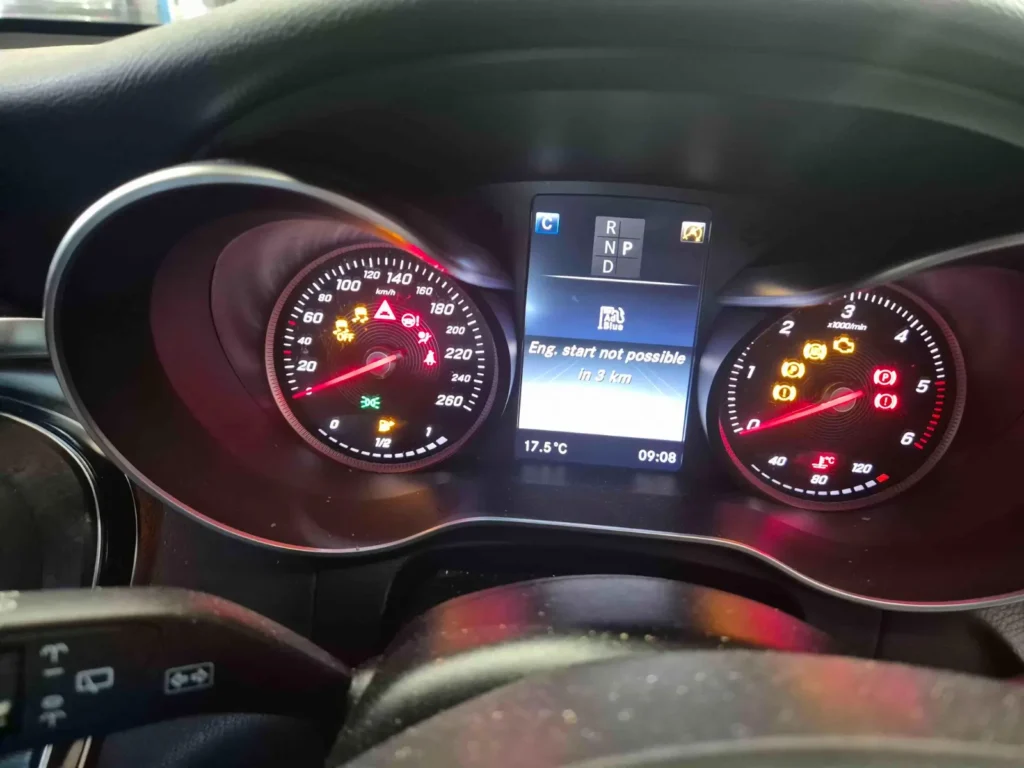
A Mercedes-Benz GLC 220 d 4MATIC arrived at our Bayswater workshop the way far too many AdBlue cars do: on the back of a tow truck, with the dash reading “Eng. start not possible in 3 km” and the owner wondering whether the car had been written off by a warning light.
It had not. What it had was a faulty AdBlue metering valve, a failed AdBlue pump and a partially blocked SCR catalyst, all announced by two fault codes that get typed into Google every day by worried diesel owners: P14031F (control unit AdBlue has a malfunction) and P20E823 (pressure in the AdBlue system too low).
This article walks through what those codes mean, why the car refuses to start, how we diagnosed and repaired this GLC, and why the same story plays out on Volkswagen, Audi, Skoda, BMW, Land Rover, Volvo and Jaguar diesels across Perth. If you are reading this with an AdBlue countdown on your own dash, the short version is: do not panic, do not keep driving it to zero, and do not let anyone throw parts at it without a proper diagnosis.
What AdBlue Actually Does in Your Diesel
AdBlue is a precisely mixed solution of urea and de-ionised water. Modern Euro 6 diesels inject it into the hot exhaust stream ahead of the SCR (selective catalytic reduction) catalyst, where it breaks down into ammonia and converts harmful nitrogen oxides (NOx) into nitrogen and water vapour.
To do that job the car needs a heated tank, a pump that builds and holds pressure, a metering valve (often called the AdBlue injector) that sprays a fine dose into the exhaust, temperature and pressure sensors, NOx sensors before and after the catalyst, and a control unit that ties it all together. Because emissions compliance is a legal requirement, the manufacturer’s software polices this system hard. If it cannot prove the SCR system is working, it starts a countdown and eventually blocks the engine from starting.
That is why an AdBlue fault feels so dramatic to owners. Mechanically the engine is fine. Legally, the car has decided it is not allowed to run.
What the Mercedes AdBlue Warning Messages Mean
Mercedes-Benz escalates its AdBlue warnings in stages, and knowing which stage you are at matters:
- “Check AdBlue” or “Refill AdBlue” with a range remaining. Usually just a low level. Top it up with genuine ISO 22241 AdBlue and the message should clear after a short drive.
- “Fault in AdBlue system” or “AdBlue system malfunction”. The control unit has detected a fault, not a low level. Topping up will not fix this and the countdown has started.
- “Eng. start not possible in X km”. The final warning. Once the distance reaches zero the car will not restart after it is switched off. This is where our GLC was sitting.
Sometimes the countdown really is caused by running the tank low and letting air into the system. Quite often, though, it points to a genuine component failure, and the only way to tell the difference is to read the fault codes properly.
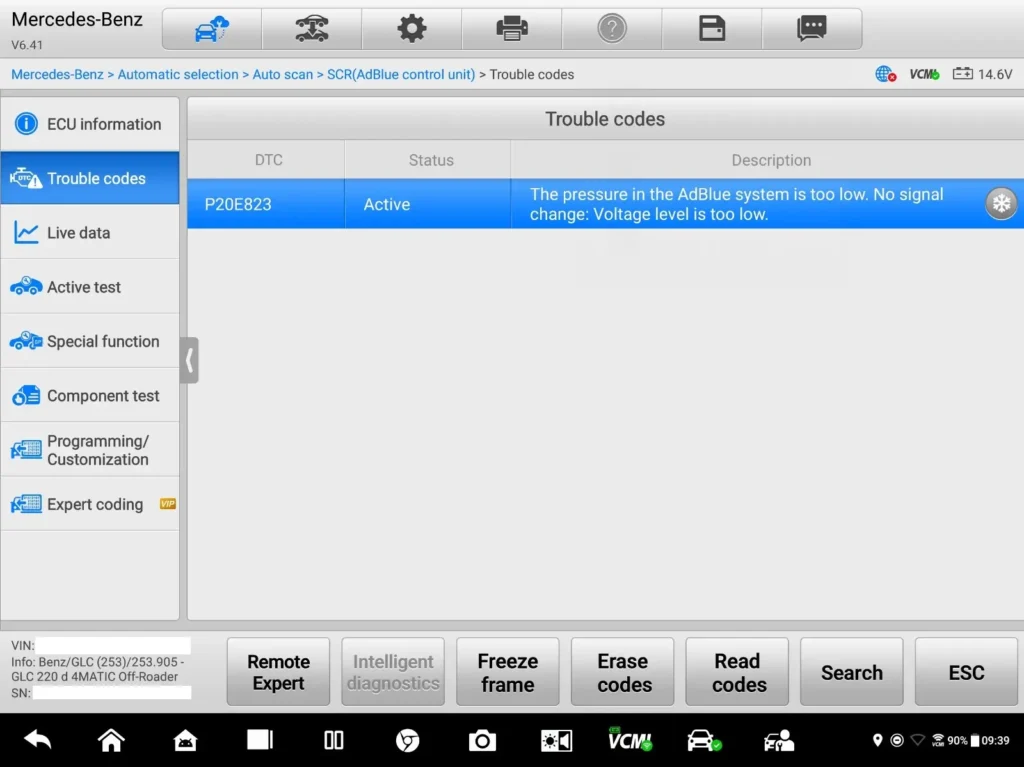
Fault Code P20E823: AdBlue System Pressure Too Low
P20E823 is stored by the SCR (AdBlue) control unit and reads, in full, “The pressure in the AdBlue system is too low. No signal change: voltage level is too low.” In plain English, the pump has been commanded to build pressure and the pressure sensor is not seeing the response it expects.
Common causes we see for P20E823 include:
- A failed or worn AdBlue delivery pump
- A blocked or stuck metering valve that has overloaded the pump
- Crystallised urea restricting the pressure line or filter
- A leak in the pressure line or at the injector seal
- A faulty pressure sensor or wiring fault
- A tank run dry, leaving air in the system
Replacing the pump on the strength of this code alone is a common and expensive mistake. If the metering valve is the reason the pump failed, the new pump will follow the old one.
Fault Code P14031F: Control Unit AdBlue Has a Malfunction
P14031F lives in the engine control unit (on this GLC, the CR43 controller for the OM651 diesel) and is best thought of as the engine computer’s summary of the problem: “The control unit AdBlue has a malfunction. There is a sporadic fault.” It is the code that triggers the “Fault in AdBlue system” message and the start restriction.
P14031F is rarely the root cause on its own. It is the engine control unit reporting that the SCR control unit has a problem, so you have to follow the trail into the SCR system to find the actual failure. On this car it sat alongside P246364 (diesel particulate filter soot content implausible), which told us the exhaust after-treatment had been compromised for a while.
The Companion Codes: P204F96, P13E400 and U144F84
An AdBlue no-start rarely arrives as a single code. The engine control unit usually stores a cluster of related faults, and reading them together is what separates a confident diagnosis from a guess. On Mercedes-Benz diesels the three below turn up again and again alongside P14031F:
- P204F96: “The AdBlue system (cylinder bank 1) has a malfunction. There is an internal component fault.” The engine control unit has been told by the SCR system that one of its own components (pump, metering valve, sensor or heater) has failed an internal check. This is the code that points you towards a hardware fault rather than a low tank.
- P13E400: “The remaining driving distance is limited due to a malfunction in the AdBlue system.” This is the countdown itself, stored as a fault. It confirms the start restriction is active because of a system fault, not because the tank is empty, and it will not clear until the underlying fault is repaired and the system reset.
- U144F84: “Signal ‘Minimum fuel level REACHED’ was received. There is a signal below the permissible limit value.” A network message reporting that the diesel tank has hit its minimum level. It is not an AdBlue fault, but it is a common passenger on cars that have been limped around on a countdown, and XENTRY treats it as a current fault that must be dealt with before the AdBlue reset will complete.
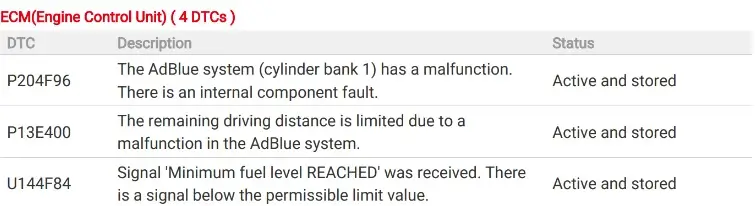
If your scan shows P13E400 with P204F96 or P14031F, treat it as a system fault from the outset. Topping up the tank is still worth doing, because a full tank is a requirement for the reset, but it will not make these codes go away on its own.
Case Study: Mercedes GLC 220 d 4MATIC With an AdBlue No-Start
With 238,000 km on the clock, this GLC was a hard-working family SUV, not a garage queen. Topping up the tank had not helped, the countdown kept falling, and by the time it reached us it was down to 3 km.
Diagnosis
Our first scan pulled P20E823 as an active fault in the SCR control unit, with P14031F and P246364 stored in the engine control unit. Live data showed the pump could not build or hold pressure. Rather than condemn the pump straight away, we inspected the metering valve and the SCR catalyst.
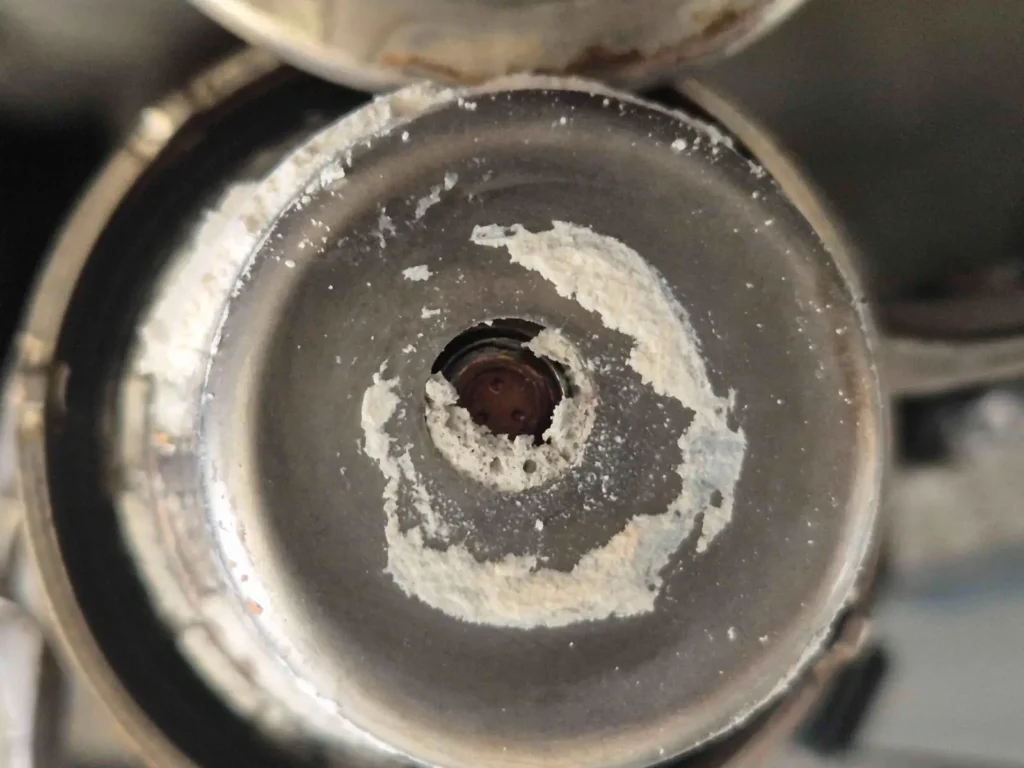
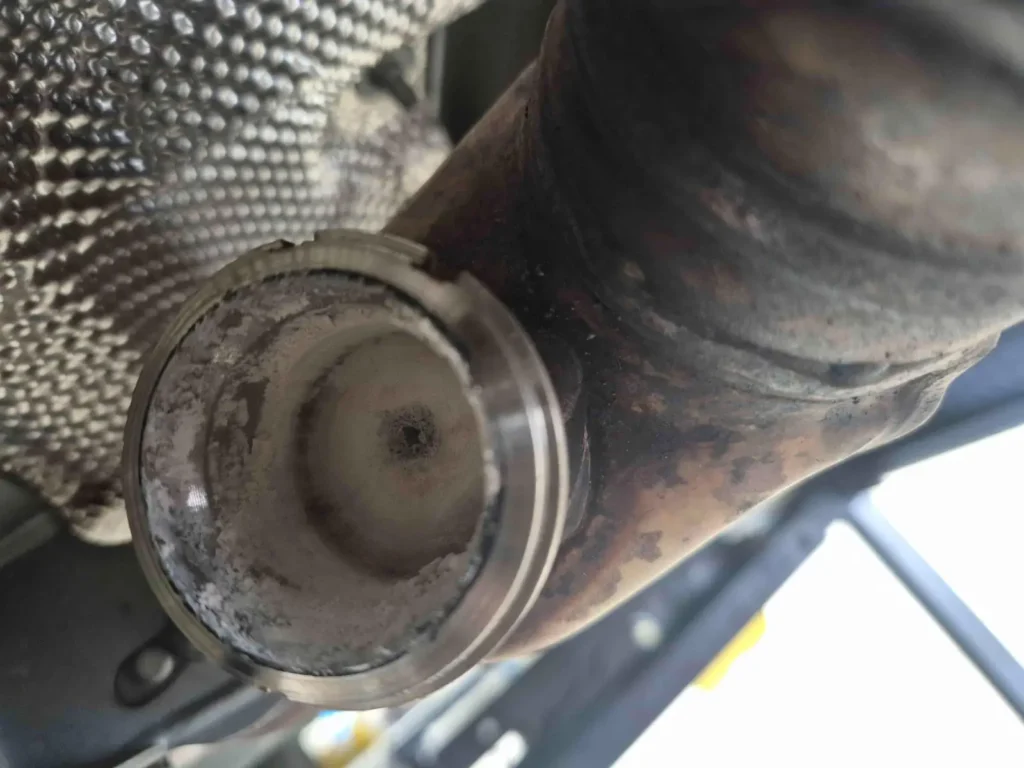
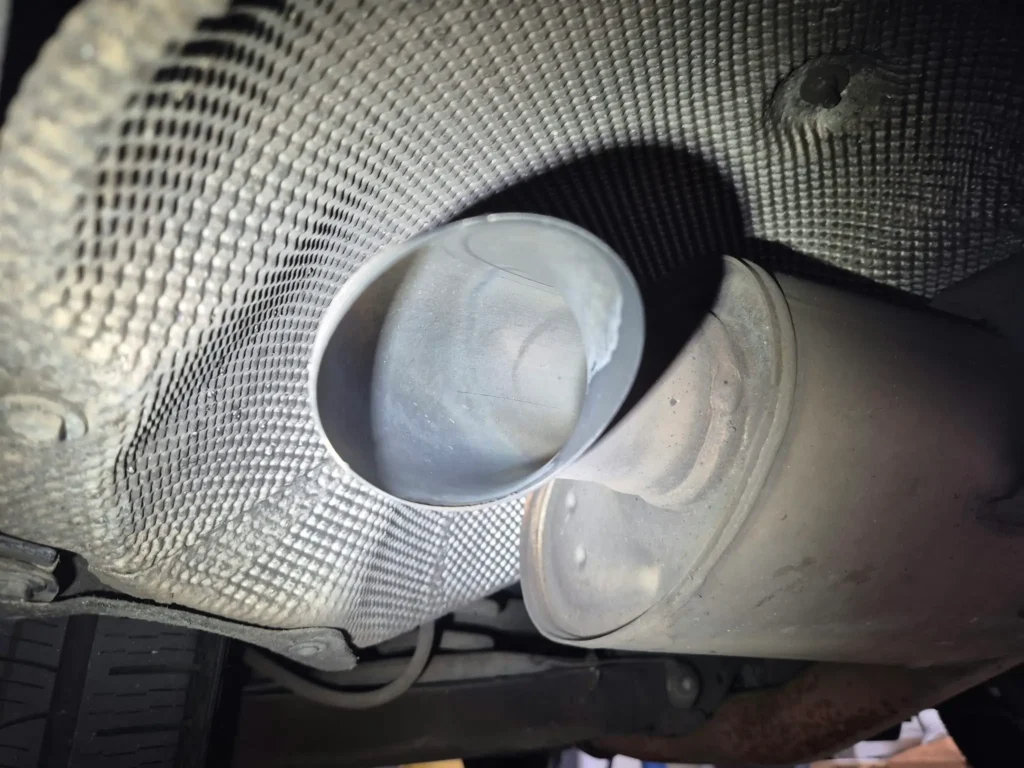
The photos tell the story. The metering valve was caked in hardened, crystallised urea. A valve in that state cannot spray properly, so AdBlue pools and crystallises around the nozzle, the pump works against a restriction until it fails, and the SCR catalyst downstream starts to block. The white deposits inside the exhaust tip are the same crystals making their way out the back of the car.
The repair
The fix was a new AdBlue metering valve and delivery pump, removal of the crystallised deposits and clearing of the SCR catalyst restriction, followed by a system fill and pressure test. Just as important was fixing the cause and the effect together. A new pump with the old valve would have been a repeat visit; a new valve with a dead pump would still not start.
Why the warning would not simply reset
Here is the part that catches out a lot of owners and general workshops. On many Mercedes-Benz models, once the start restriction has been triggered the car does not just forgive you when the parts are replaced. The engine control unit needs to be told, through the manufacturer’s own diagnostic system, that the SCR system is healthy again.
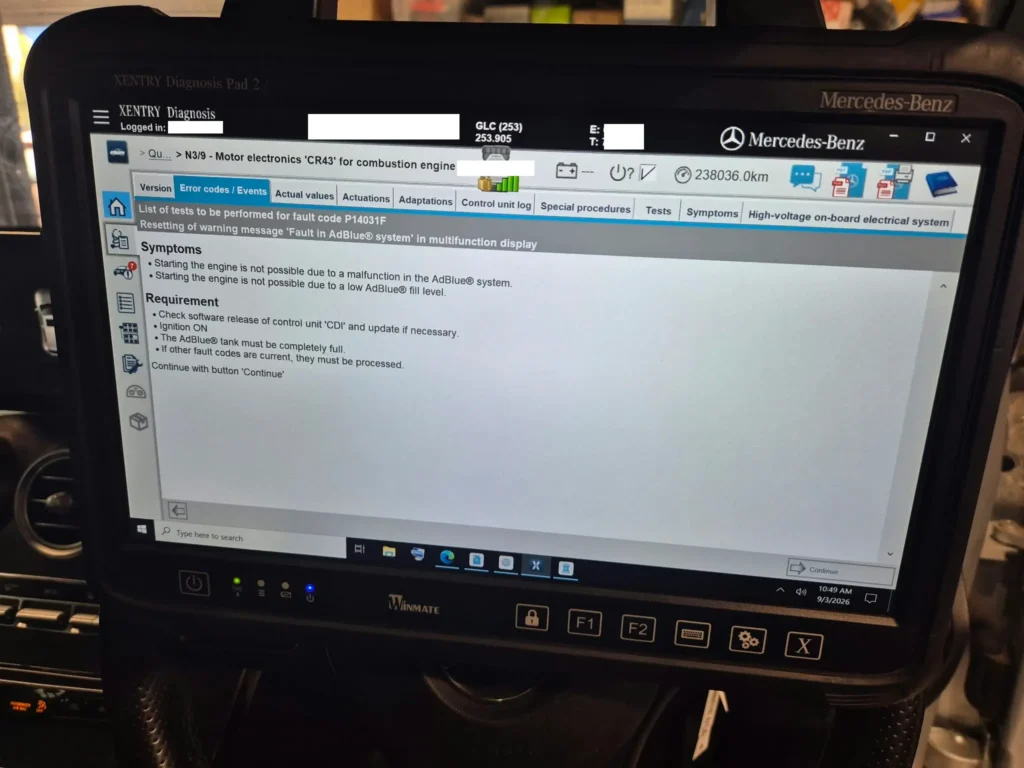
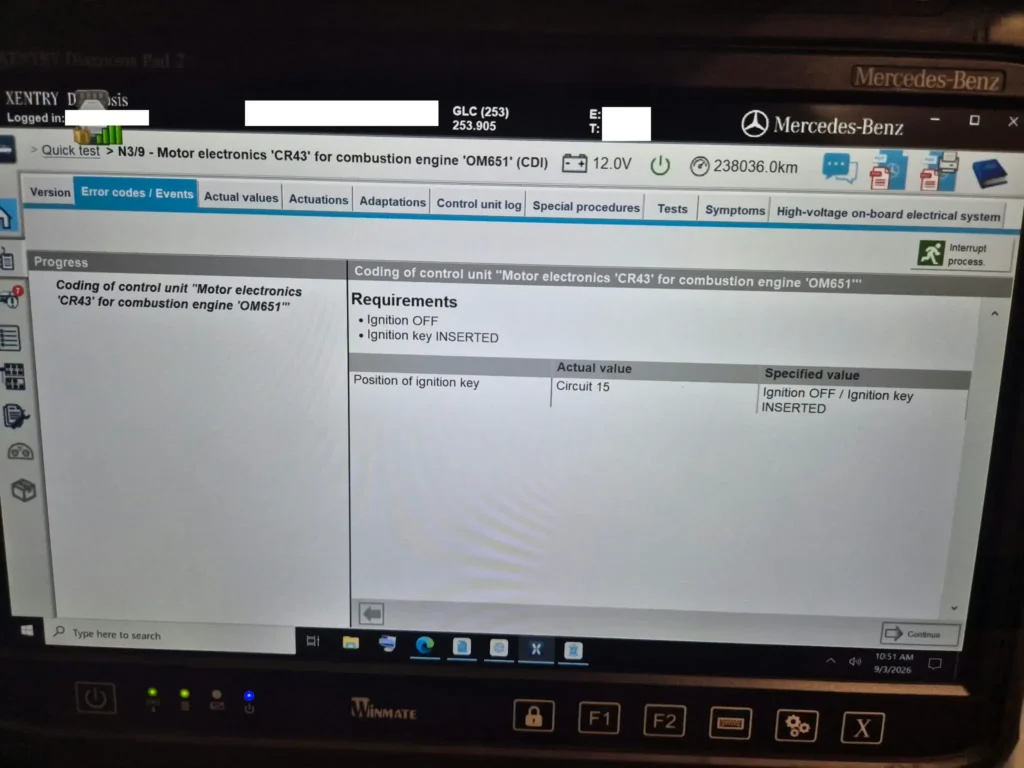
On this GLC that meant connecting our genuine Mercedes-Benz XENTRY Diagnosis Pad, running the guided test for P14031F (“Resetting of warning message ‘Fault in AdBlue system’ in multifunction display”) and performing an online SCN coding of the CR43 engine control unit. SCN coding talks directly to Mercedes-Benz servers in Germany. A generic scan tool, however good, cannot do it. XENTRY also insists on a full AdBlue tank and all other current faults processed before it will complete the reset, which is exactly how it should be.
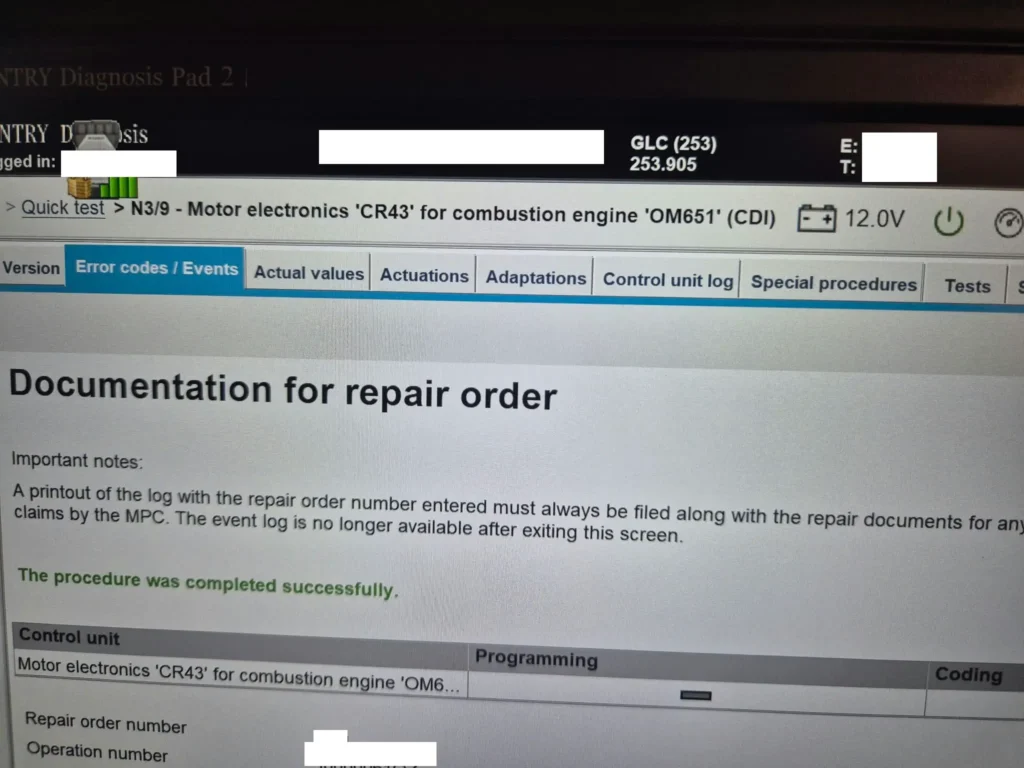
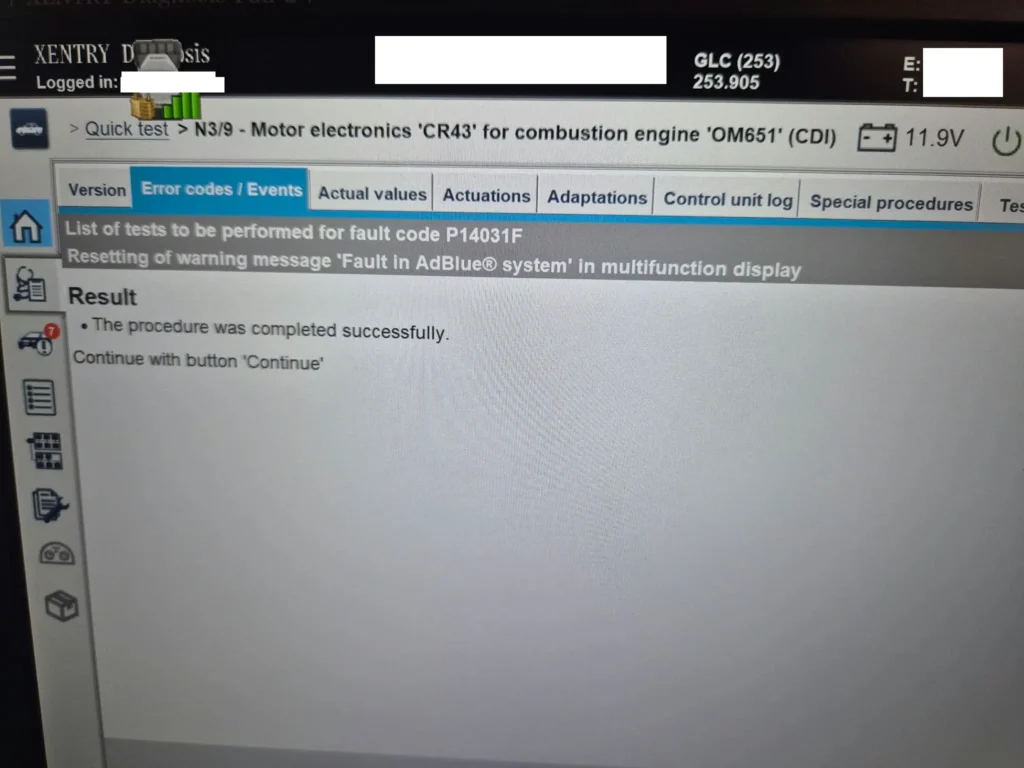
With the reset complete, the GLC started and drove out under its own power. The exhaust tip tells the rest of the story.
The Most Common Causes of AdBlue Faults
We frequently have cars dropped off with AdBlue warnings and a remaining distance, and the causes vary far more than owners expect. Across the European diesels that come through our workshop, the usual suspects are:
- Metering valves (AdBlue injectors) blocked with crystallised urea or failed electrically
- Delivery pumps worn out or destroyed by working against a blockage
- Temperature sensors in the tank or exhaust reporting implausible values
- NOx sensors failing or drifting, so the control unit cannot verify the catalyst is working
- Tank heaters and level sensors, particularly on older tank units
- Leaks in pressure lines, at the injector seal or from a cracked tank
- Blocked SCR catalysts from long-term under-dosing or crystal build-up
- Contaminated or poor quality AdBlue, or a tank that has been run completely dry
Diagnosing these faults correctly is essential, because getting it wrong is expensive. AdBlue tank units, pumps and NOx sensors are not cheap parts, and swapping the wrong one still leaves you with a car that will not start. Over the years we have become very experienced in pinpointing exactly what has failed and quoting an accurate repair at a fair price, rather than guessing at the customer’s expense.
Not Just a Mercedes Problem: VW, Audi, Skoda, BMW, Land Rover and Volvo
Every manufacturer selling a Euro 6 diesel in Australia uses an SCR system, and every one of them enforces it with a countdown. The wording changes; the mechanics do not.
- Volkswagen, Audi and Skoda (the 2.0 TDI and 3.0 TDI families) show “AdBlue: no engine start possible in X km” and store codes such as P20E8 and P204F. Many faults in these systems require VAG ODIS to reset or adapt the new components.
- BMW and Mini diesels display “Diesel exhaust fluid range” warnings and can suffer from tank unit, heater and metering valve failures.
- Land Rover, Range Rover and Jaguar Ingenium diesels are known for DEF (diesel exhaust fluid) injector and tank-level sensor faults that trigger a no-start countdown.
- Volvo D4 and D5 diesels use a similar SCR set-up and the same countdown logic.
Some cars will reset the remaining distance on their own once the SCR system is functioning correctly again. Many will not, and in those cases specialised diagnostic tools are required to connect to the manufacturer’s servers and enable vehicle start again. This is why we run genuine Mercedes-Benz XENTRY, VAG ODIS for Volkswagen, Audi and Skoda, and a range of other specialist tools for BMW, Land Rover, Range Rover, Jaguar and Volvo, so we can get our clients back on the road rather than sending them to a dealer.
What to Do When the AdBlue Warning Appears
- Read the message carefully. A refill warning and a system fault warning are two very different problems.
- Top up with genuine AdBlue if the level is low. Use a sealed container that meets ISO 22241 and never use anything that is not AdBlue. If the message clears after a drive, you are done.
- If the message says “fault” or “malfunction”, book a diagnosis promptly. The countdown will not reverse on its own and every kilometre you drive brings you closer to a car that will not restart.
- Do not let the countdown reach zero away from home. A tow is far more inconvenient than a booked appointment.
- Insist on a fault-code driven diagnosis before any parts are quoted, and ask whether the workshop has the factory software needed to reset the system afterwards.
AdBlue Diagnosis and Repair in Perth
Whether your Mercedes is showing P14031F, your Audi is counting down to no engine start, or your Range Rover has thrown a DEF injector fault, the approach is the same: proper diagnosis with the right tools, repair of the actual cause, and a factory-level reset so the car stays fixed.
Our Mercedes-Benz specialists and diagnostic technicians deal with AdBlue and SCR faults week in, week out, and our AdBlue system servicing and repairs page covers what we check and fix. If your car is already immobilised, we can arrange for it to come to us. If it is still driving, contact Eurotech Autohaus in Bayswater today and we will get it booked in before the countdown does the deciding for you.
Frequently Asked Questions
Yes, until the remaining distance reaches zero. After that the engine will not restart once switched off. Driving on the countdown is legal but risky, because you may end up stranded and need a tow.
Usually not. These codes indicate a system fault rather than a low level. Topping up is still a sensible first step, and a full tank is required before the fault can be reset, but the underlying cause must be found and repaired.
On many Mercedes-Benz, Volkswagen Group and other European models, no. Once the start restriction has triggered, the reset requires the manufacturer’s diagnostic software, such as Mercedes-Benz XENTRY or VAG ODIS, connected online to the factory servers.
White, chalky deposits inside the exhaust tip are crystallised urea from AdBlue that is not being dosed and burnt off correctly. It is a strong sign of a faulty metering valve or a blocked SCR catalyst and is worth having inspected before a warning appears.
No. Removing or disabling emissions equipment is illegal in Australia and would leave the vehicle unroadworthy. A correctly repaired SCR system is reliable, so the right answer is to fix the fault properly.
It depends entirely on which component has failed, which is why a proper diagnosis comes first. A sensor or metering valve is a very different job from a tank unit or SCR catalyst. We quote the actual repair once the fault is confirmed, not a guess.
About the Author

Rainer Scholz is the Workshop Manager and a diagnostic specialist at Eurotech Autohaus, an independent European vehicle workshop in Bayswater, Perth. He was the lead technician on the GLC 220 d repair featured in this article.
A German-trained master tradesman with over 20 years of experience on European and German cars, he works daily with factory and aftermarket diagnostic equipment including genuine Mercedes-Benz XENTRY and VAG ODIS, and has diagnosed and repaired AdBlue and SCR faults across the full range of European diesels.
Eurotech Autohaus is a licensed Motor Vehicle Repairer (MRB9066) and MTAWA member, servicing prestige and performance European vehicles across Perth’s north-eastern suburbs.
SERVICE QUOTE
24 Radius Loop, Bayswater WA 6053
Monday – Thursday: 7:30am – 5pm
Friday: 7:30am – 4pm
Our Services
AdBlue System Servicing & Repairs
- AdBlue Fault Diagnosis
- AdBlue Warning & Countdown Reset
- Metering Valve & Injector Replacement
- AdBlue Pump & Tank Repairs
- NOx & Level Sensor Replacement
- SCR Catalyst Crystallisation Cleaning
- Mercedes, BMW, Audi, VW & More
Brake Servicing
- Brake Inspection & Diagnosis
- Disc Brake Service
- Drum Brake Service
- Master Cylinder
- ABS Diagnosis
- Brake Fluid Flush
Car Electrical Services
- All lighting and modifications
- Control module diagnosis
- Alternators, Batteries
- Starters
- Air Bag System Diagnosis and repair
- Accessories and upgrades
- Windshield Wipers & Washers
Collision Advice
- Insurance Claims
- Vehicle Restoration
- Body Kits
- Glass Replacement
- Custom Graphics
- Interior & Exterior Trim
- All Makes and Models
Comfort System
- Air Conditioning Service
- System Diagnosis
- Heater Core
- A/C Compressors
- Blower Motors
- Climate Control System
Cooling System
- Leak Diagnosis
- Overheating Diagnosis
- Water Pumps
- Radiators
- Cooling Fans
- Coolant Hoses
- Thermostats
Engine Performance
- High Performance Upgrades
- Drivability Diagnosis
- Fuel Injection Service
- Computer System Diagnosis
- Maintenance Tune-Up
- Emission Diagnosis & Repair
- “Check Engine” Light Diagnosis
Engine Servicing
- Oil Leak Diagnosis
- Timing Belts
- Performance manifolds and accessories
- Head Gaskets
- Engine Replacement
- Engine Service
- Exhaust System Replacement & Repair
- Performance Upgrades
Maintenance Services
- Factory protected log book servicing
- Full 100 safety point inspections
- Transmission Service
- Cooling System Flush
- Tyre Rotation & Balance
Pop and Crackle Tunes (Burble Tunes)
- Stage 1 Tuning
- Stage 2 Tuning
- Stage 3 Tuning
- Fuel Efficiency Tuning
- Engine Remapping